
Deep Winter is cold and wild and wet. This year in particular we seem to have been plunged into the worst of the season, even before the winter solstice has passed. One of the benefits of winter is the rain, which prompts the growth of some of my favourite plants in the relatively mild climate of southern Victoria. Globe artichokes (Cynara cardunculus var. scolymus), giant honey-flower (Melianthus major) and honeywort (Cerinthe major) are some of the plants I love to see come to life in the wetter months. They all have glaucous foliage, and it is one of the marvels of winter to see water pooling in the valleys formed by leaves and by stems, like quicksilver, glinting in the morning light.
Another of these winter treats is the wallflower. Once known as Cheiranthus, the genus Erysimum is a long favourite of gardeners who like maximum effect for minimum input. You might remember seeing them in London used as a bedding plant, with magnificent tulips emerging from their froth of colour, if you have been there in spring time.
There are scores of cultivars in existence, some with descriptive and exotic names like ‘Cloth of Gold’, ‘Apricot Twist’, ‘Vulcan’ and ‘Persian Carpet’. The names might give an indication of the range of colours available, burnt orange, pale lemon, canary yellow, all sorts of purple and some might say red.
I have four varieties that I have experience using. I only bought one of them. That is the wildly popular Erysimum ‘Bowle’s Mauve’, which you can find out all about with a quick google search. It’s foliage is dense, made up of lance-like leaves, the shrub is compact and it flowers in a very pleasing shade for months on end, as they all do. Starting with the autumn break and continuing until early summer.
The other three have landed here so many years ago, I have forgotten their provenance and even their cultivar name, if ever I knew them. Most likely they came from friends as cuttings in moistened newspaper. For they strike very readily from cuttings and they grow well from seed. However, I find they are a rather enduring shrub in my gardens so I don’t need to renew them very often. I prune them back after flowering with the hedge trimmers to keep them shapely. They tend to hibernate over summer: they stop flowering, their foliage shrinks and becomes more glaucous to cope with the drier conditions.
As I said, I am not sure of the exact names of my cultivars, in fact I have a feeling one of them is an unnamed seedling anyway. But the three I have demonstrate their great colour range.
The most vigorous is the one that looks like it could be ‘Artists Paintbox’, which is a feast of divers colour all on its own. One website describes the flowers of this variety as exhibiting all of the following: ‘yellow-orange, salmon, purple-pink, and reddish-purple’!
The variety known as ‘Early Sunrise’ is multicoloured too, but possibly in a more refined way, leaping between pale lemon yellow and lavender. The plants I have in the garden that look like this cultivar might actually be seedlings of the above mentioned ‘Artists Paintbox’ that have popped up on their own in the gravel and mulch.
My all time favourite is the burnt orange variety that closely resembles ‘Fire King’. I have grown this cultivar from the earliest days and in multiple settings. It always impresses with its brilliant, warm tone.
The great value of these plants on top of their reliability and impact is the way their strong winter growth blocks out the innumerable wet season weeds that rise up throughout the garden (cleavers, fumitory, capeweed and to name a few).

Erysimum cultivar at the end of the season, this is usually when I give them the chop


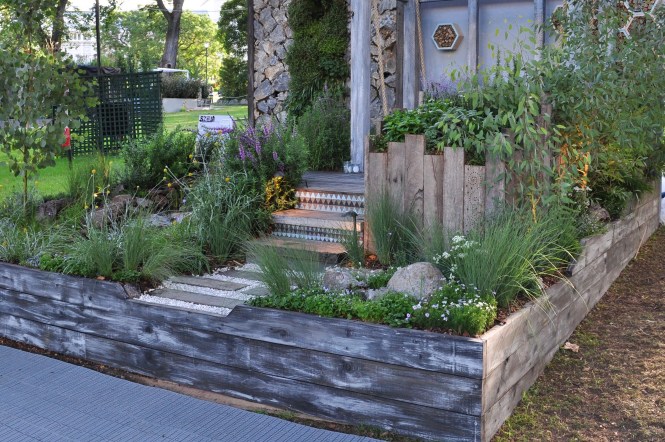 Maybe it’s a reaction against the glamourous outdoor lifestyle gardens of recent times, with their monochrome colour palettes, their outdoor kitchens hinting at a life of material ease (‘you wish’) and suggesting that at any moment one could dive into the oscillating reflection of the ubiquitous swimming pool, before retiring without a care to the professionally-finished powder-coated perforated metal arbour to look out and admire the polished bluestone pavement. Or maybe it’s a reaction to the overbuilt urban context in which so many of us live these days, accompanied by our anxiety for the destruction of the natural world. I can’t be sure, but this year at MIFGS the judges in each of the three categories, were very much rewarding a more natural approach. The winning gardens incorporated a rich diversity of plants, with an emphasis on indigenous species that will offer homes to native insects and animals. They uses natural materials and ‘improved’ them by adding intricate details to those materials.
 The planting was mostly indigenous, with exotic food and medicinal plants topping up the display. The designer created interesting artistic vignettes within the overall ‘wild’ feeling of the planting. From within what at first seemed a fairly routine interpretation of a native bushland arose the energetic tousling of the Purple Loosestrife (Lythrum salicaria) and Billy Buttons (Pycnosorus globosus), which was delightful in terms of both form and colour. Nearby was an elegant study in creamy white, mauve and grey-green. White brachyscome, Ozothamnus diosmifolius, and the ground hugging native violet (Viola hederacea) were enlivened by some glaucous foliage of poa. The delicate beauty of Wahlenbergia stricta and Vanilla Lily (Arthropodium sp.) completed the picture with a few small blue and purple flowers. Such attention to detail seemed to be part of the winning formula this year.
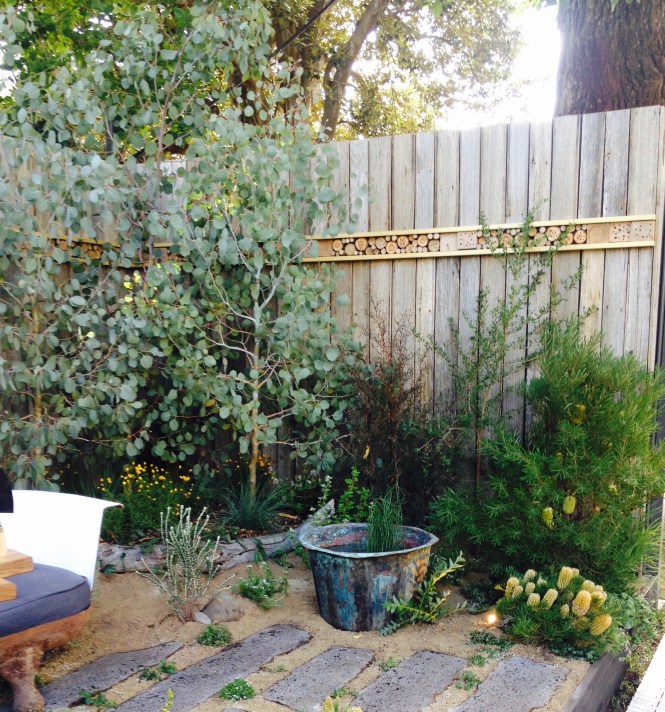 I can’t wait to see how this natural garden revival plays out over time.
 It seems to me that one of the many challenges of creating an instant garden at something like MIFGS 2017, is that the garden designer must strike a balance between including some showstopping features (ahead-of-the-trend hardscaping and furnishings; intricate detailing and visual diversity; idiosyncratic and expertly composed panting schemes), while at the same time creating a calm space with a sense of unity of design that does not appear over-stuffed or over the top. And, of course, all within a week or so with all the other limitations of the show ground site.
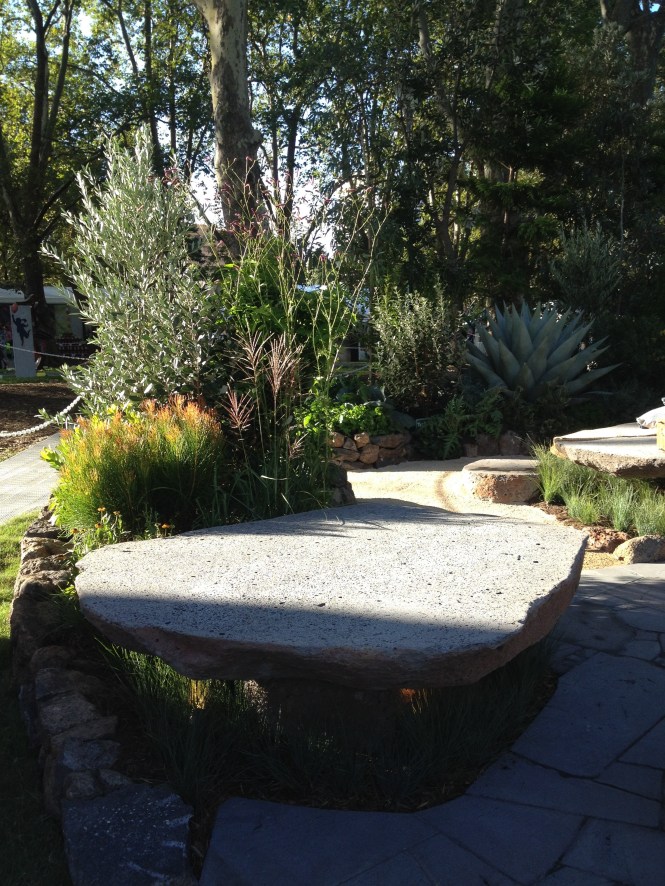


 Matthew Henry Gardens