Boxes of Dahlias

DSC_0001

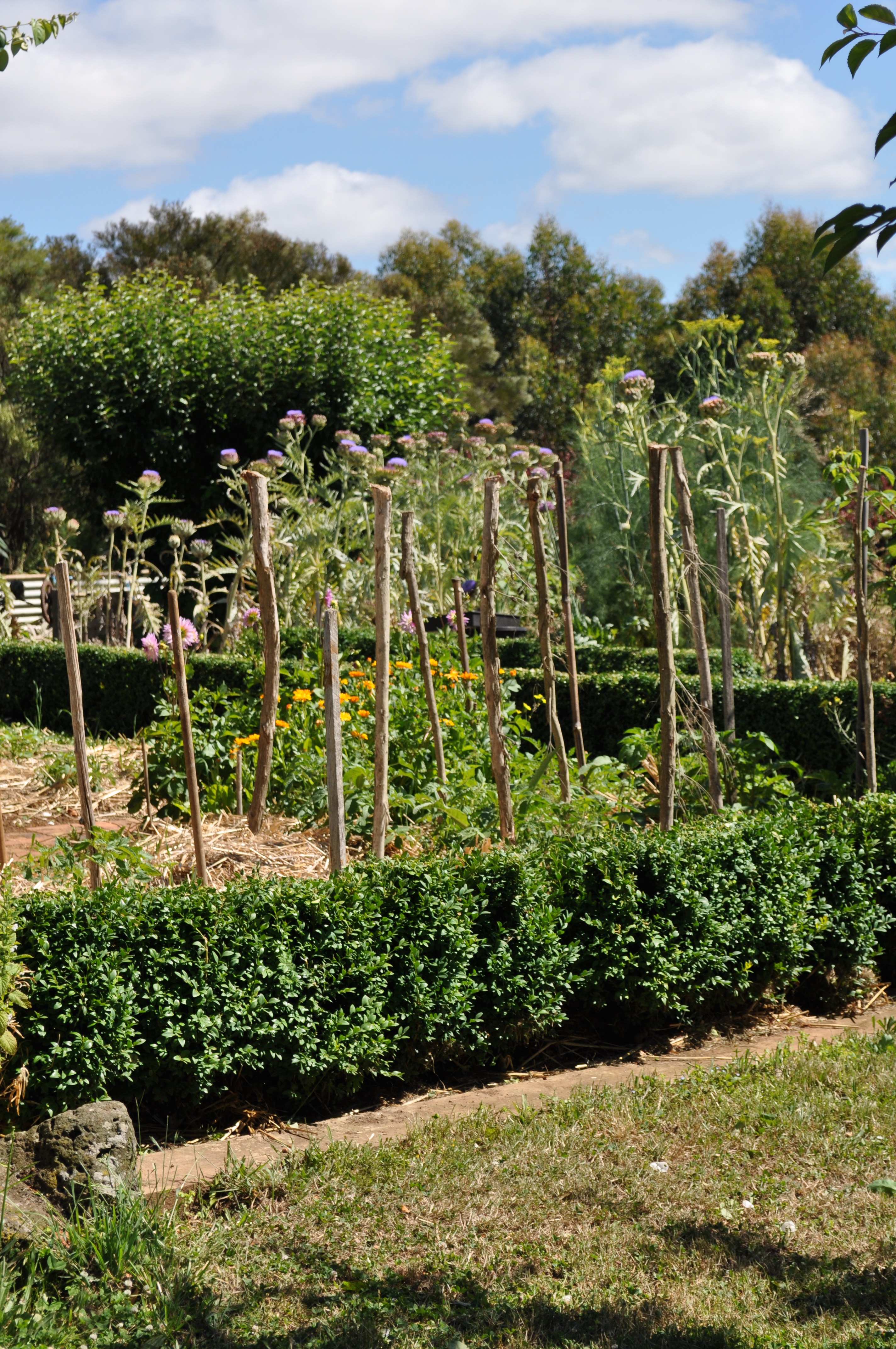
Where do you stand on box hedges? Do you view them as a classic staple of formal gardening or a lamentable gardening cliche that were old hat when Vita Sackville-West was a lass?

Probably, from the above photograph, you have worked out where I stand. My vegetable garden at Clear Springs is defined by these rustling lines of deep green. Box although haling from the Old World are as tough as any native in my garden and will forgive me when I don’t get around to clipping them. I can hack back inches and still they reveal glossy green foliage that look like I had planned it this way all along. It looks great all year round and is happy to take the supporting role to the more spectacular floral offerings, like the dahlias, calendula and artichokes that you can see in the photograph.

And now allow me to mention the dahlias. My grandmother grew them: a great big fat row of them that ran the full length of one of Pa’s vegetable gardens. No two plants were the same variety, the flowers all astounded me as a child. Their colours and shapes absorbed my fascination.

I grew some myself in my first little garden. Dainty white pompoms. I thought they were a miracle.

And as I grew up, I realised that they were not terribly fashionable so kept my interest in them quiet, unless it was for the giant tree dahlia, which was somehow ok according to the horticultural fashion police of the time.

But in my wonderings and observations of old style productive gardens of the inner urban migrants of multicultural Melbourne, I noticed that these proto-cottage gardens were usually adorned with a splendid example of a dahlia. Usually the most garish and strangely coloured dahlia known to science. There might be quite a few plants, but of the one variety. Frugal gardeners dividing and multiplying a specimen that they love. Makes sense.

And thus my own little row of dahlias. One variety that I acquired as a gift fifteen years ago. It has grown in the same place pretty much since then and unlike my industrious grandparents, who dug and stored away the bulbs every year so that they wouldn’t rot, mine have remained untended and undivided. That is, until now. Only a few months ago I divided and replanted about half the bulbs in a little row, expecting them to grow into great big shrub like creatures before flowering in the late summer.

However, the division must have somehow stimulated their urge to flower and low and behold I had a lovely little display for Christmas. The combination with the calendula pleases me greatly and not just for the serendipitous nature of its creation. What would the fashion police say? Hopefully, by now I have learnt not to listen too much to the pronouncements of these mythical creatures.

DSC_0007

Happy New Year!

Melbourne Grasslands

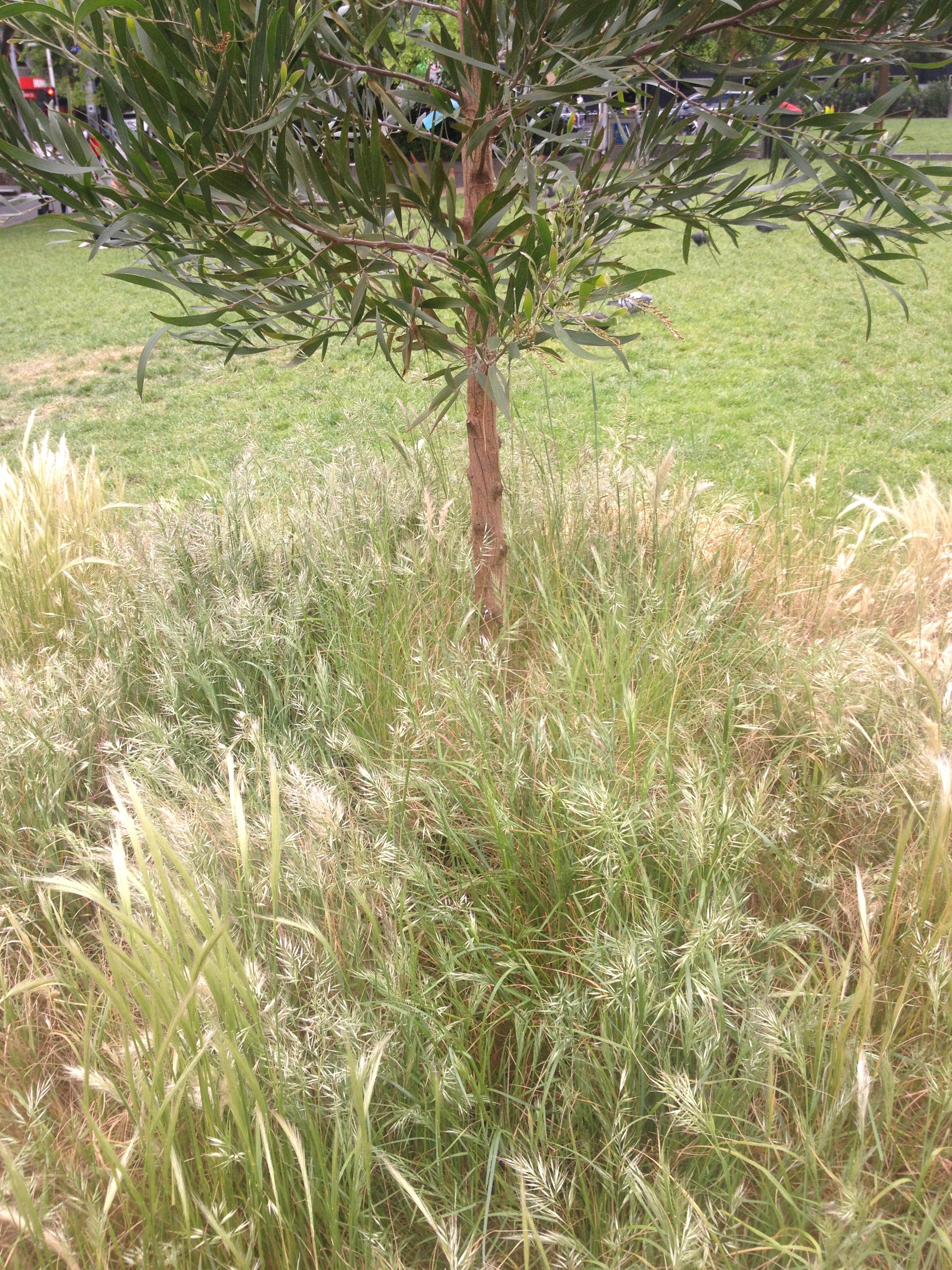
The artist, Linda Tegg, has reminded Melbourne of its own history in her installation, Grasslands, which graces the steps of the State Library of Victoria.

Grasslands shows the citizens of Melbourne the predominant flora, the grassy woodlands, that extended across much of what is now inner urban and suburban Melbourne. The juxtapositioning of the installation against one of the buildings that most reminds us of our European cultural heritage is asking us questions about change, colonial contact with indigenous culture and the devastation of pre European indigenous landscapes. When both library and grassland are considered in the context of a modern city and its relentless taste for development, the reminder of a long forgotten natural world is like a breath of fresh air.

It’s on until the 23rd November and after that time the plants will be given away to winners of the #librarygrasslands Instagram competition.

A great swathe of indigenous grasses that would once have grown naturally across much of Melbourne before 1835.

A great swathe of indigenous grasses that would once have grown naturally across much of Melbourne before 1835.

Redmond Barry looks down on the kangaroo grass and other species. I'm not sure whether he approves of not.

Redmond Barry looks down on the kangaroo grass and other species. I’m not sure whether he approves or not.

It's not all about the poaceae; these bulbine lilies and trigger plants contribute to the tapestry.

It’s not all about the poaceae; these bulbine lilies, dichondra and trigger plants contribute to the tapestry.

This young blackwood (Acacia melanoxylon) forms a subtle focal point amidst the ebb and flow.

This young blackwood (Acacia melanoxylon) forms a subtle focal point amidst the ebb and flow.

Brunonia and anthropodium twinkling from amidst the grasses.

Brunonia and anthropodium twinkling amidst the grasses.

Torches, torches

IMG_4078

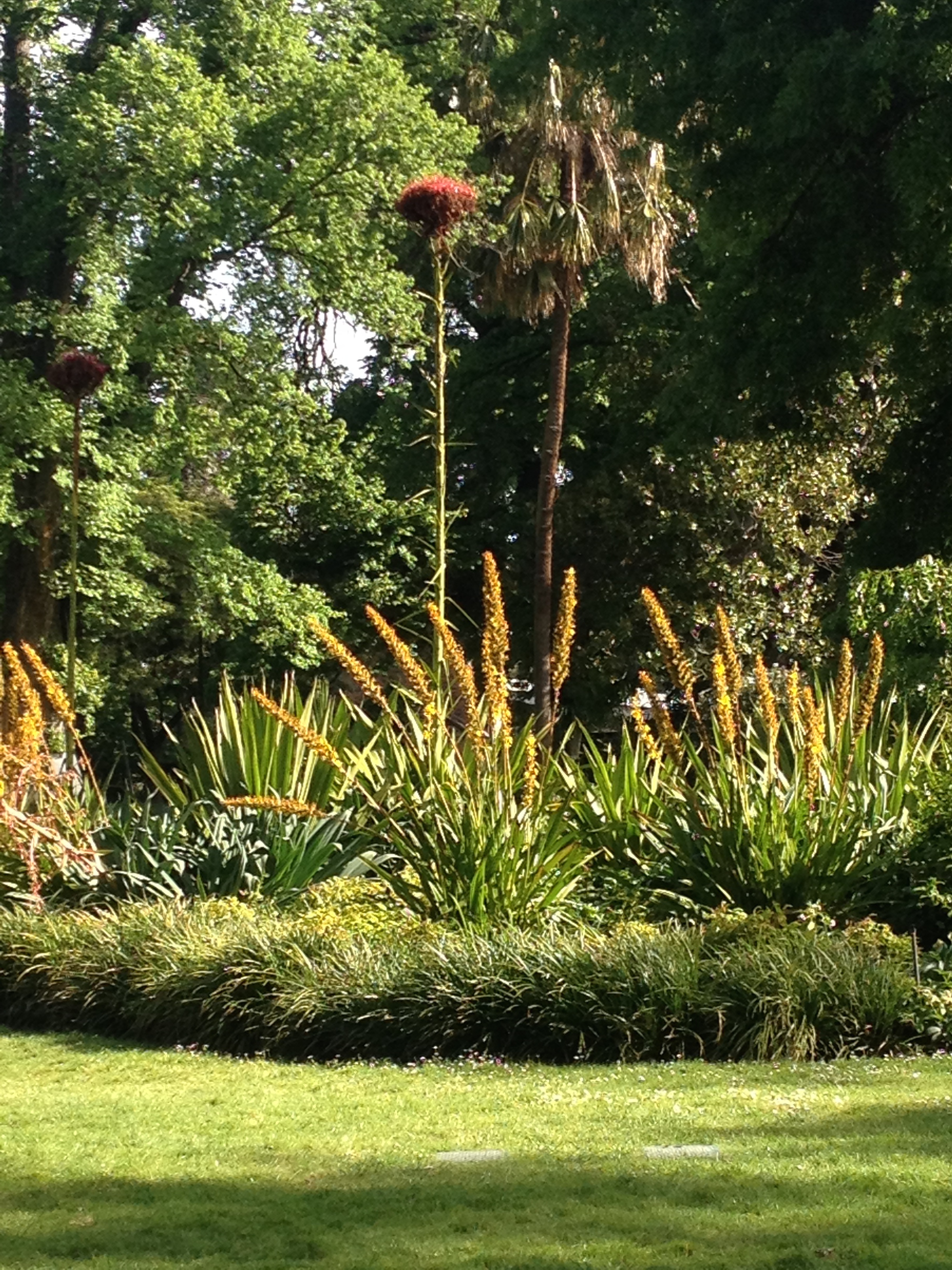
The thyrsus was a symbolic implement from ancient times made of a rod with a pine cone fixed on the top. It was associated with Bacchus or Dionysus, and in the midst of this silly season and the Spring Carnival in Melbourne, when Dionysus’ bacchanalian cult seems to be active at every Cup Day barbecue and racing event, it is quite fitting to be reminded of it by a rather upright planting in the Fitzroy Gardens this sunny spring afternoon.

The radiant golden racemes of the Wachendorfia thyrsiflora (where the thyrsus reference comes from)  are in full splendour at the moment. The timing of this planting to coincide with the stunning Doryanthes exelsa’s flowers (towering above on their immense stem) is impressive.

Both are fairly tough plants as long as they have adequate water (I find the Wachendorfia won’t flower if it dries out). If you want to find out more, check out the links below.

http://www.plantzafrica.com/plantwxyz/wachendorfthyrs.htm

http://www.anbg.gov.au/gnp/gnp12/doryanthes-excelsa.html

Rosy

IMG_3973

When I arrived at ‘Clear Springs’ in classic spring drizzle, the colours of the seasonal blossom and flower glowed brightly in the mute light, against the grey sky. It was Thursday and ahead of me lay four days in the garden, before I had to go back to the city and to work. And in front of me, on a grassy path, lay Mme Alfred Carriere. She lay sadly beside the verandah post she was supposed to be attached to. She looked like a badly broken limb: at the wrong angle and disconcerting.

IMG_3972

An instant sense of guilt came. I had meant to prune all the roses on my previous visit, but had only managed to trim a few of the bush roses, daunted no doubt by the mammoth task of thinking out and tidying up the vigorous old lady of the climbing rose world. My failure to act meant that she was too top heavy and the wires that supported her buckled in the heavy winds.

My initial dread subsided somewhat when I discovered that she had slumped rather than snapped. I figured I could reattach her.

It didn’t take long.

Once righted, she stood proudly again and I picked a few of the exquisite buds that were beginning to open and enjoyed the rosy fragrance from the cream flowers, so palely stained with pink, the margin of the outer petals a wrinkled, cerise edge. These colours usually bleach away in the bright sun, but this grey day had kept the precious colours vivid.

Sharing

photo 1 

Horticulture in urban areas is widely becoming a vehicle for conscious community building. The popularity of community gardens is a testament to that. Meeting friends and neighbours amidst the kale and parsley is the way to go. I get it. I like it. And, some creative people are always thinking of new ways to expand this concept, often by using the internet to connect people. This can be seen in the groovy concept set up by a few blokes in the inner north of Melbourne, with their project HerbShare. I hope they continue with the idea, even though their crowd sourcing venture has not yet been successful. Check out their Facebook page to find out more. https://www.facebook.com/theherbshare 

How did I find out about them? I stumbled on this quirky little planting in a bluestone alleyway in North Carlton. An old plastic tub, a television carapace and a rather retro pepsi crate serve as the containers for the herbs which are grown here for the person who planted them and also for any of the neighbours who might like a sprig of mint for their peas. One less thing to buy at the supermarket. One more reason to connect with your neighbours. 

Wintry

photo 3

The days are getting longer. But it is still winter. The plants grow, but slowly. Broad beans (Vicia faba) have been growing steadily since we planted them in May. And they are flowering their sweet, cream flowers that promise the fruit that is to come. I planted the broad beans in three rows, fairly closely together so that the plants support each other as they grow. Nearby I grow a small crop of garlic, another of my favourite winter crops. All in a bed of rich red soil that I have tried valiantly to keep weed free over the course of the winter. I wish I could keep the whole garden like that. Elsewhere the cape weed and blue pimpernel are also thriving. That will be a job for another day, when the days get longer still.

Seminal

photo

Even blurry photos of beetroot seedlings kindle a feel good state of mind as the days lengthen and the sun shines on a winter’s day in August. Knowing that there is still snow on the mountains does nothing to stop the hope of warm growing weather being just around the corner. The little glasshouse at my local community garden allows me to satisfy my premature planting urges. At our last working bee we planted all sorts of summer delights, such as tomatoes and sunflowers, which we will hopefully pot on in this safe environment until all risk of frost has passed. Here’s hoping for more photos later on as the growing season unfurls…

Creepy

The space is small and the conditions are harsh. This little bed is about 40cm wide between the bluestone alleyway and the asphalt path to the letter box. It is about a metre long. Sometimes, when we are reversing out of the alley, we impinge on its borders. This spelt the end of the inappropriately chosen Phormium tenax cultivar that had been growing there sparsely for a number of years. We replaced it with a Lomandra longifolia we had been given and it keeps the remaining phormium company. But really it is a bland little planting.

A ground hugging creeper could be a solution. I had it in my mind to carpet the bed with Corsican Mint (Mentha requienii), so that when traffic (foot or automotive) strays onto the bed, there will be a lovely crushing of leaves and a release of creme-de-menthe aroma.

The problem of course is that I could not find a trace of this plant in any of the nearby nurseries. Too impetuous to order the plant that I wanted and had spent some time planning on buying, I hastily grabbed two ground-huggers that might fulfil a similar function of softening this stony spot without getting in the way.

In retrospect of course I realise that they are not compatible bed fellows, one preferring dry and the other moist conditions. But as I am not sure what the conditions of the ground really are (we have heavy clay hereabouts, it being an old brick making area, so ‘moist’ isn’t out of the question, but I’m not sure that the soil in this bed is 100% local, so it might possibly be dry after all). Maybe I am simply hedging my bets.

photo 2

The two plants are Pennyroyal (Mentha pulegium) and Woolly Thyme (Thymus pseudolanuginosus). Here are preliminary photographs of each. I will take some more pics as the season progresses. Happy gardening.

photo 1